Who is booked is not the same question as who is cleared to load in.
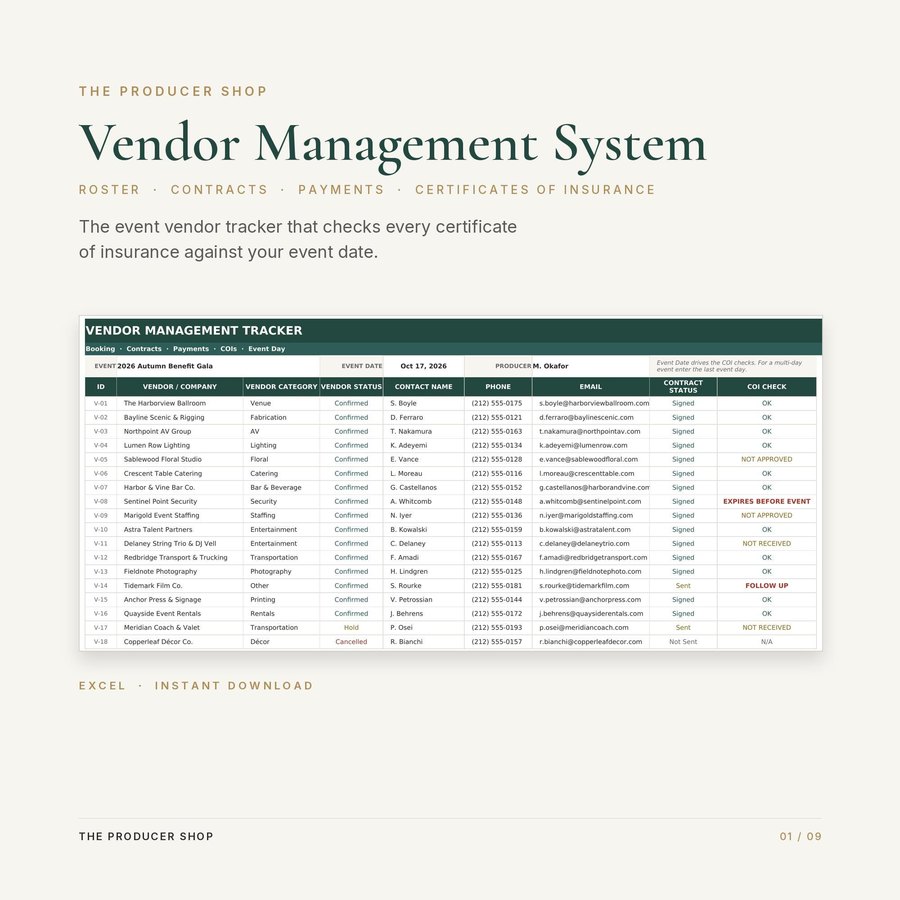
On most events, everything you know about your vendors lives in a dozen email threads. The one thing you cannot see from any of them is which vendor is not actually cleared to be on site.
A missing certificate of insurance stops a load in. So does one that expires the week before the show, and one that arrived naming the wrong additional insured and was never chased. None of these are creative problems. They are tracking problems, and they are the ones that quietly derail otherwise flawless events.
The insurance check is calculated
Enter the event date once. Log each certificate as it arrives: carrier, coverage type, general liability, aggregate, workers comp, auto, additional insured, the dates requested and received, effective and expiration, status, and a follow up date you choose.
The COI check column returns one answer per vendor, in priority order: EXPIRED, EXPIRES BEFORE EVENT, FOLLOW UP, NOT RECEIVED, NOT APPROVED, OK, or not applicable for a vendor you have cancelled.
A certificate requested three months out reads NOT RECEIVED without shouting at you. On the follow up date you set, the same row turns into FOLLOW UP. An approved certificate that lapses before your event date reads EXPIRES BEFORE EVENT while there is still time to fix it.
You never type an insurance status on the vendor roster. It is pulled from the certificate log, so the two cannot disagree.
The rest of the vendor, on the same row
Category, status, contact, contract status, contract total, deposit paid, balance due, payment status, load in and call time, notes. Each row carries a fixed ID linking it to the certificate log, so two vendors with similar names never cross wires.
Contract total and deposit paid only accept numbers, so a stray TBD cannot break a total. A deposit larger than its contract is flagged. A vendor entered twice is flagged on both sheets.
The dashboard counts the problems separately
Active vendors, vendors confirmed, contracts outstanding, payments outstanding, deposits paid, certificates outstanding, and the four kinds of insurance problem counted individually: not received, requiring follow up, expired or expiring before the event, and not approved.
Cancelled vendors are left out of every figure, which sounds obvious until you have used a tracker where they were not.
Multi day events
Enter the last event day as the event date, so a certificate that lapses in the middle of the run is caught rather than passing the check on day one.
Who buys it
Event producers, production companies, agencies, venues, hotels, caterers and hospitality teams. Anyone responsible for the people who make an event happen, and for proving they are insured to be there.
What you download
One ZIP, four items. The workbook with four tabs, fifty vendor rows ready to fill, a worked example, a start here readme, and a page explaining what else in the shop overlaps with it.
The worked example is a one night nonprofit gala with eighteen vendors, real contract values, deposits, balances and call times, and a certificate log in which several vendors are not yet clear, so you can see what the checks look like when they catch something.
The blank workbook opens clean. No sample data to delete.
Get the Vendor Tracker on Etsy, $28