The number you quote, and the number you have to stand behind.
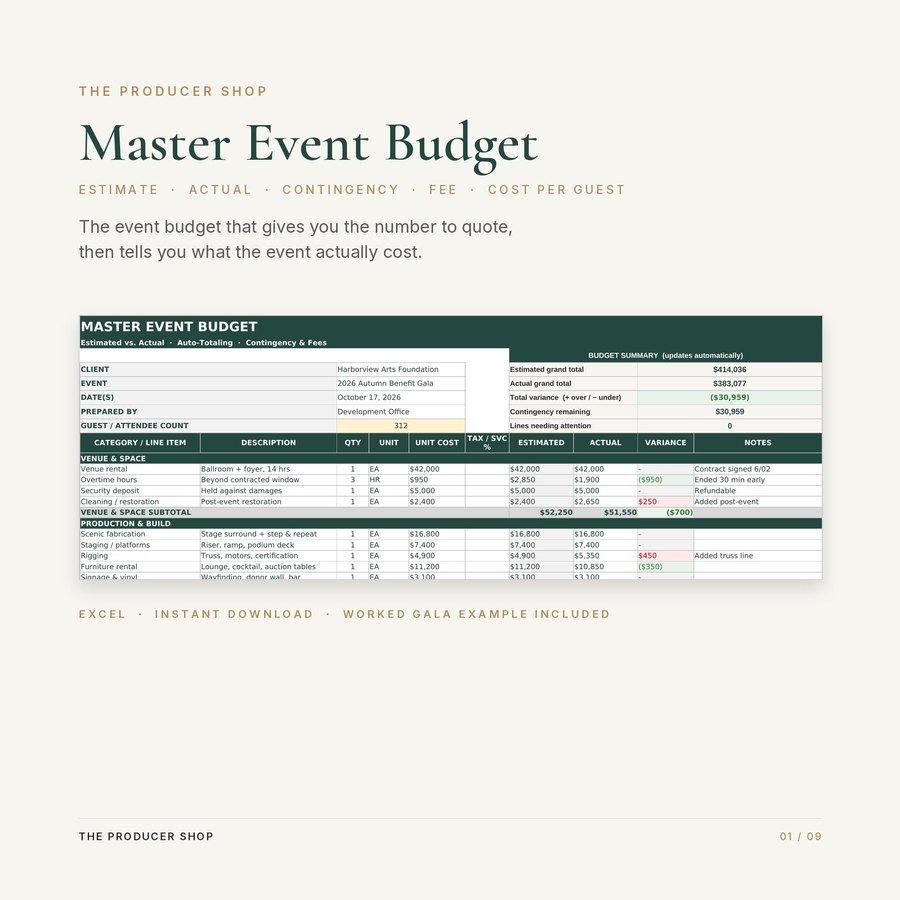
The number you quote is the number the client remembers. The number you deliver is the one they judge you on. Most budget templates only help with the first one. They add up a column and stop.
This workbook keeps both, side by side, in the same file, so the close out reads the way the proposal did.
Contingency is a reserve, not a cost
This is the thing most templates get wrong and it distorts every number that comes after it.
Your estimated grand total includes contingency, because that is the number the client approves. Your actual spend does not, because a reserve is not a cost until you draw on it. You record what you draw. The workbook shows what is left, and it warns you when invoiced lines have run over their estimates by more than you have recorded drawing.
The fee follows your contract, not the template's opinion
One dropdown: a percentage of estimated direct costs, a percentage of actual direct costs, or a fixed amount. Whichever cell does not apply greys out. You should not have to rewrite a formula because this client's agreement is structured differently from the last one's.
One bad cell cannot take the sheet down
Quantity, unit cost and actual cells only accept numbers. If something slips through, that line reads CHECK, the totals keep calculating without it, and the summary counts how many cells need attention.
TBD goes in the notes column, where it belongs, instead of quietly zeroing out a category.
What is in it
Ten cost categories: venue and space, production and build, AV, lighting and power, permits and insurance, catering and beverage, staffing and labour, talent and entertainment, logistics, creative and content, guest and marketing. Forty-five line items, each with quantity, unit, unit cost, an optional tax or service charge percentage, estimated, actual, variance and notes.
Tax and service charge are per line and optional. Enter the rate that applies to a rental or a catering line and the estimate grosses up. Leave it blank on lines you price all in. No rate is assumed anywhere, because no two markets are the same.
The summary tab is calculated. Direct costs, contingency reserved, used and remaining, the fee with its basis spelled out, estimated against actual grand totals, direct cost per guest and all-in cost per guest, and all ten categories with each one's share of direct costs. It prints on one page for the client meeting.
Lines can be added anywhere
Copy a line, insert it between the category header and its subtotal, and the subtotal picks it up. If a line ever ends up outside a category, the total direct costs row tells you rather than silently dropping it.
The worked example is a finished budget
A 312 guest nonprofit gala, priced, invoiced and closed. Approved at $414,036, closed at $383,077, with $30,959 of contingency never drawn. Open it first to see how a finished budget reads, then work in the blank one.
Who buys it
Event producers, production companies, agencies, venues, hotels, caterers, nonprofits and hospitality teams. Anyone who has to put a number in front of a client and then stand behind it.
What you download
One ZIP, four items. The workbook with three tabs, the worked gala, a start here readme, and a page explaining what else in the shop overlaps with it.
This exact workbook also ships inside The Everything Bundle, the Product Launch Kit, the Brand Activation Kit, the Location Scouting Kit and the Corporate Conference Kit. If you own one of those, you already have it. Message before you buy if you are not sure.
Get the Event Budget Template on Etsy, $24