How to plan a fundraising gala that actually raises the money
A fundraising gala is two projects wearing one dress.
One is a live event: a room, a dinner, a stage, a guest experience and a program that has to start and end on time.
The other is a fundraising campaign with a hard deadline, where hundreds of decisions are being made in service of one number.
That distinction matters. It is entirely possible to produce a beautiful gala, fill the room, stay on schedule and still miss the financial goal.
Plan the money first. Then plan the room.
Start with the net, not the gross
Before you choose the flowers, entertainment or invitation stock, establish the number that actually matters: net proceeds.
Gross revenue is everything the event brings in.
Net proceeds are what remain after the event has been paid for.
If a gala raises $300,000 and costs $90,000 to produce, it has generated $210,000 for the organization. It also cost 30 cents to raise each dollar.
That cost-to-raise-a-dollar number is useful because it forces production decisions into the same conversation as fundraising. A $7,000 upgrade is no longer simply "better lighting." It is $7,000 that now has to be raised somewhere else.
Build a real expense budget from the beginning. Venue, catering, rentals, production, AV, entertainment, décor, printing, technology, staffing, security, auction costs, payment processing, transportation, gratuities and anything else the event requires.
Then add contingency.
Do not hide contingency inside other numbers. Give it its own line. Something will change.
For internal event management, keep cash revenue and in-kind support separate. A donated auction item, complimentary rental or discounted vendor fee can have meaningful value, but it is not cash available to pay the caterer. Track both. Do not confuse them.
Build the revenue plan before you build the party
A $500,000 gala goal is not a fundraising strategy.
You need to know where the $500,000 is supposed to come from.
Break the revenue target into actual channels:
- sponsorship and underwriting
- tables
- individual tickets
- pre-event gifts
- live appeal or paddle raise
- live auction
- silent auction
- other event fundraising
Then assign a target to each.
If you expect $200,000 from sponsors, $125,000 from tables and tickets, $100,000 from the appeal and $75,000 from auctions, you now have a plan that can be managed.
More importantly, give every revenue stream an owner.
Someone owns sponsorship.
Someone owns table sales.
Someone owns auction procurement.
Someone owns the appeal.
"Development" is not an owner. A person's name is an owner.
Once those targets exist, the event dashboard should tell you whether each one is on pace. Otherwise you can be three weeks from the gala, technically at 70 percent of goal and completely unaware that the remaining 30 percent was supposed to come from a sponsorship pipeline that has gone cold.
Count only the money that is real
This is where gala forecasts get optimistic very quickly.
A sponsor who said "we're in" over coffee is not $25,000 of revenue.
Neither is a board member saying they are "pretty sure" they can fill a table.
Use stages.
For sponsors, that might be:
Prospect → Verbal → Committed → Invoiced → Paid
For tables:
Prospect → Reserved → Guest names received → Invoiced → Paid
Show the entire pipeline, but do not give every stage the same weight.
Your team should be able to answer three different questions at any point:
How much could we raise?
How much has actually been committed?
How much cash have we collected?
Those are three different numbers.
A gala can look fully funded on paper while the organization is still carrying tens of thousands of dollars in unpaid invoices and verbal commitments.
The same rule applies after the event. A pledge made during the appeal is not collected revenue until it is paid.
Price from the financial model, not from last year
Ticket and table pricing often gets carried forward because "that's what we charged last year."
Start with the economics instead.
What does one guest cost you to put in the room?
What portion of the ticket price is actually contributing toward the fundraising goal after food, beverage, rentals and service?
What are sponsors receiving that makes a $10,000, $25,000 or $50,000 commitment make sense?
And how much of the night's goal are you expecting to raise after guests are already seated?
A $1,000 ticket does not necessarily mean you raised $1,000. If the event costs hundreds of dollars per guest to produce, the distinction matters.
The same is true of sponsorship packages. Do not create six tiers because every gala has six tiers. Build packages around the level of support you need and benefits you can actually deliver.
Then track those benefits. Logo placement, tickets, tables, program recognition, stage mentions, signage and other commitments have deadlines too.
A sponsor should not have to email the week of the gala asking where to send their logo.
The countdown, in the order things lock
Galas are built backwards from the event date.
The things with the fewest alternatives lock first.
Six months out and earlier. Set the event date, venue, net fundraising goal, preliminary expense budget, revenue model, ticket and table pricing and sponsorship strategy. Identify the people responsible for each major revenue target.
Four to five months out. Sponsorship outreach should be active. Confirm honorees, host or emcee, fundraising format and major vendors. Decide whether you are doing a live auction, silent auction, paddle raise or some combination before people start procuring things simply because someone offered them.
Two to three months out. Invitations and ticket sales are moving, auction procurement is underway, sponsor fulfillment is being tracked, menu decisions are happening and the first real run of show is being built. Confirm the venue's insurance, access, loading, security and vendor requirements now, not the week of the event.
Four to six weeks out. Chase outstanding RSVPs and guest names. Begin seating. Collect meal choices. Draft scripts. Build the paddle raise. Confirm who is making the ask and how pledges will be recorded. Start the production and load-in schedule.
The final two weeks. Finalize the caterer guarantee, seating, place cards, registration list, scripts, production schedule and contact sheet. Confirm sponsor deliverables. Confirm required insurance documentation. Test the fundraising and payment technology. Rehearse the run of show out loud.
If the event date changes, all of those deadlines change with it.
Your planning system should move them automatically rather than requiring someone to find and retype forty dates.
Seating is a data problem
The seating chart is where the guest list, table sales, RSVPs, meal choices, donor relationships and social politics all collide.
It is also where bad systems reveal themselves.
Do not maintain one RSVP list, another meal spreadsheet, a seating diagram and a separate check-in document if all four contain versions of the same people.
Keep one master guest list with one row per person.
That person's record should contain their RSVP, table affiliation, seat assignment if you are assigning individual seats, meal selection, host or sponsor relationship and anything the front-of-house team actually needs to know.
Assign the guest to a table once.
Your table counts, meal counts and check-in list should come from that information.
Before the final guarantee goes to catering, look specifically for:
- confirmed guests with no table
- people assigned to more than one table
- tables above capacity
- missing meal choices
- table buyers who have not supplied guest names
There is always one.
Do not treat check-in as an administrative detail
The guest experience begins before anyone sees the centerpieces.
If 150 people arrive at once and spend twenty minutes trying to find their names, change a guest, provide a credit card and locate their table, you have started the night with friction.
Decide in advance how guests will:
- check in
- receive their table information
- register a card if needed
- bid or donate
- make a pledge
- pay
- collect auction items
- receive a receipt
Then train the people running those systems.
Do not test the process for the first time while the first board member is standing at registration.
The run of show is where the money gets asked for
A gala program has one section that deserves disproportionate attention: the ask.
Call it the appeal, fund-a-need, paddle raise or mission moment. It is the point at which the emotional case for the organization becomes an immediate financial decision.
Protect it.
Do not bury it after a forty-minute awards program when the room has started checking its phones.
Know who introduces it.
Know who makes the ask.
Know what story or content leads into it.
Know the giving levels.
Know whether gifts will be made by paddle, QR code, text, pledge card or another system.
Know who is recording them.
Know what appears on the screens.
Know how the auctioneer, host, development director, spotters and production team are communicating.
And know how the segment ends.
Then build the rest of the program around that moment.
A real run of show is minute by minute. It includes walk-ons, walk-offs, videos, resets, applause, introductions and transitions, not just speeches.
A three-minute speech is not a three-minute segment if it requires an introduction, a walk to the stage, applause and a walk back to the table.
That is how twenty-minute delays are built thirty seconds at a time.
Keep the show document and the production schedule separate
The run of show tells the people running the program what happens once the event is live.
The production schedule tells the people building the event how it gets there.
They are related, but they are not the same document.
Your production schedule should cover access, deliveries, rentals, staging, lighting, sound, décor, catering, registration setup, rehearsal, doors, breakdown and load-out.
Your run of show should cover doors, seating, welcome, dinner service, videos, speakers, awards, appeal, auction, entertainment and closing.
The lighting crew needs both.
Your emcee does not.
Vendor paperwork can stop an event before it starts
Every vendor should be tracked against the basics: contract value, deposit, balance, payment due dates and primary contact.
Then track the operational requirements.
Does the venue require a certificate of insurance from that vendor?
Does the certificate need particular additional insured language?
Is there a loading dock appointment?
A freight elevator reservation?
A union requirement?
A security credential?
A delivery restriction?
An approved vendor list?
A beautifully designed ballroom is irrelevant if a truck cannot get into the building.
Put those requirements in the plan when the vendor is hired, not in an email search at 7:00 a.m. on event day.
The gala does not end when the band stops
There is still money to collect.
Within the first days after the event, reconcile the appeal, auctions, ticket and table balances and outstanding sponsorship invoices.
Follow up on unpaid pledges while the night is still fresh.
Send receipts and auction documentation.
Thank guests, sponsors, table hosts, donors, volunteers and the people who helped open doors.
Then close the event financially.
What was the final gross?
What were the final expenses?
What was the net?
What did it cost to raise a dollar?
Which revenue streams beat the plan?
Which missed?
How much of the projected revenue was actually collected?
Document the answers while everyone still remembers what happened.
The debrief is not just "the room looked great." It is the beginning of next year's gala.
The mistakes that cost the most
Starting with production instead of revenue. You can design a $150,000 event before anyone has proved there is a credible path to raising $400,000.
Counting pipeline as cash. Verbal commitments and prospective tables belong in the forecast. They do not belong in the bank balance.
A budget with no contingency. Something will change. Budget for that before it does.
No owner for each revenue stream. "The committee is working on sponsors" is how sponsorship goals get missed.
Nobody owning the ask. The appeal needs planning, rehearsal and production just like the entertainment does.
Building the program before designing the appeal. The most financially important part of the evening should not get whatever five minutes are left.
Multiple versions of the guest list. If development, catering, seating and registration are working from different lists, they will eventually disagree.
Waiting until the final week for sponsor assets and guest names. You will spend the final week chasing logos instead of producing the event.
Treating event night as the finish line. Outstanding pledges, invoices, receipts, donor follow-up and financial reconciliation are still part of the gala.
The dashboard that is a person. If the only way to know where the event stands is to ask the one person keeping it all in their head, the organization will discover it is behind when that person is on vacation.
A working gala planning template
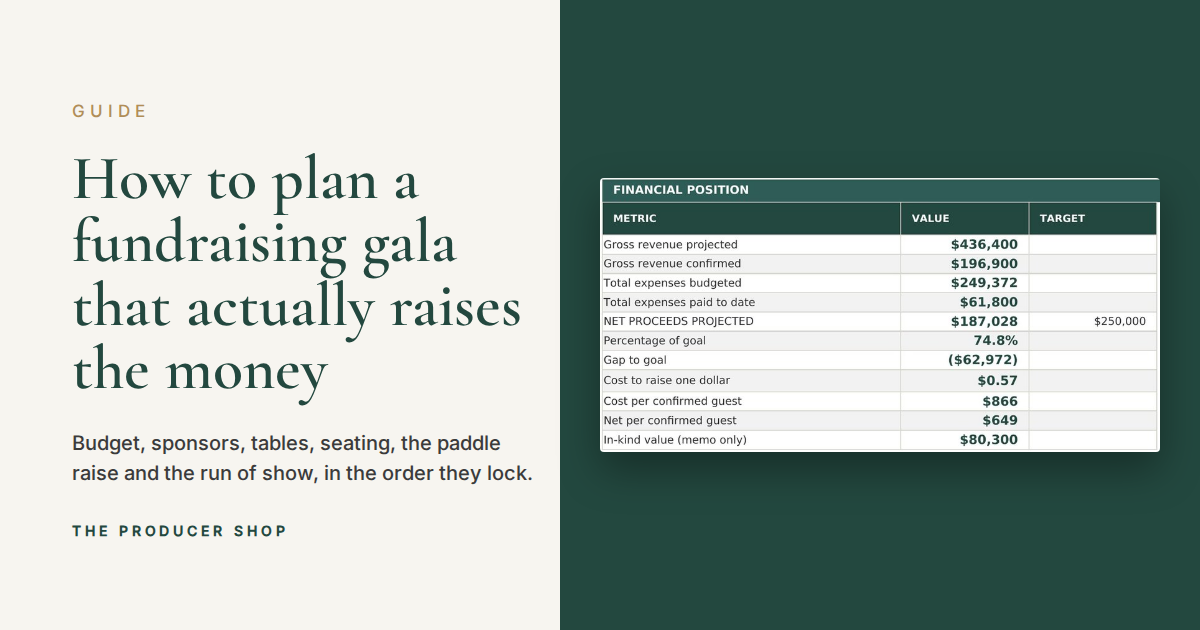
This is exactly why I built the Gala Command Center.
It is one Excel workbook with thirteen connected tabs designed around how a gala actually gets planned.
Enter the event date, venue, fundraising goal and pricing once. The dashboard then tracks net proceeds against goal, cost to raise a dollar, sponsorship by status, RSVPs, meal counts, vendors, insurance, milestones and the rest of the moving pieces.
The guest list feeds seating. Seating feeds table counts. Meal selections roll up automatically. The run of show recalculates when timing changes. The 39-milestone countdown moves when the event date moves.
Most importantly, the fundraising dashboard separates money you are pursuing from money that has actually been committed and collected, so the number at the top of the sheet means something.
The workbook arrives filled with a complete worked gala, so you can see how the entire system works before replacing it with your own event.
Get the Gala Command Center on Etsy, $39